
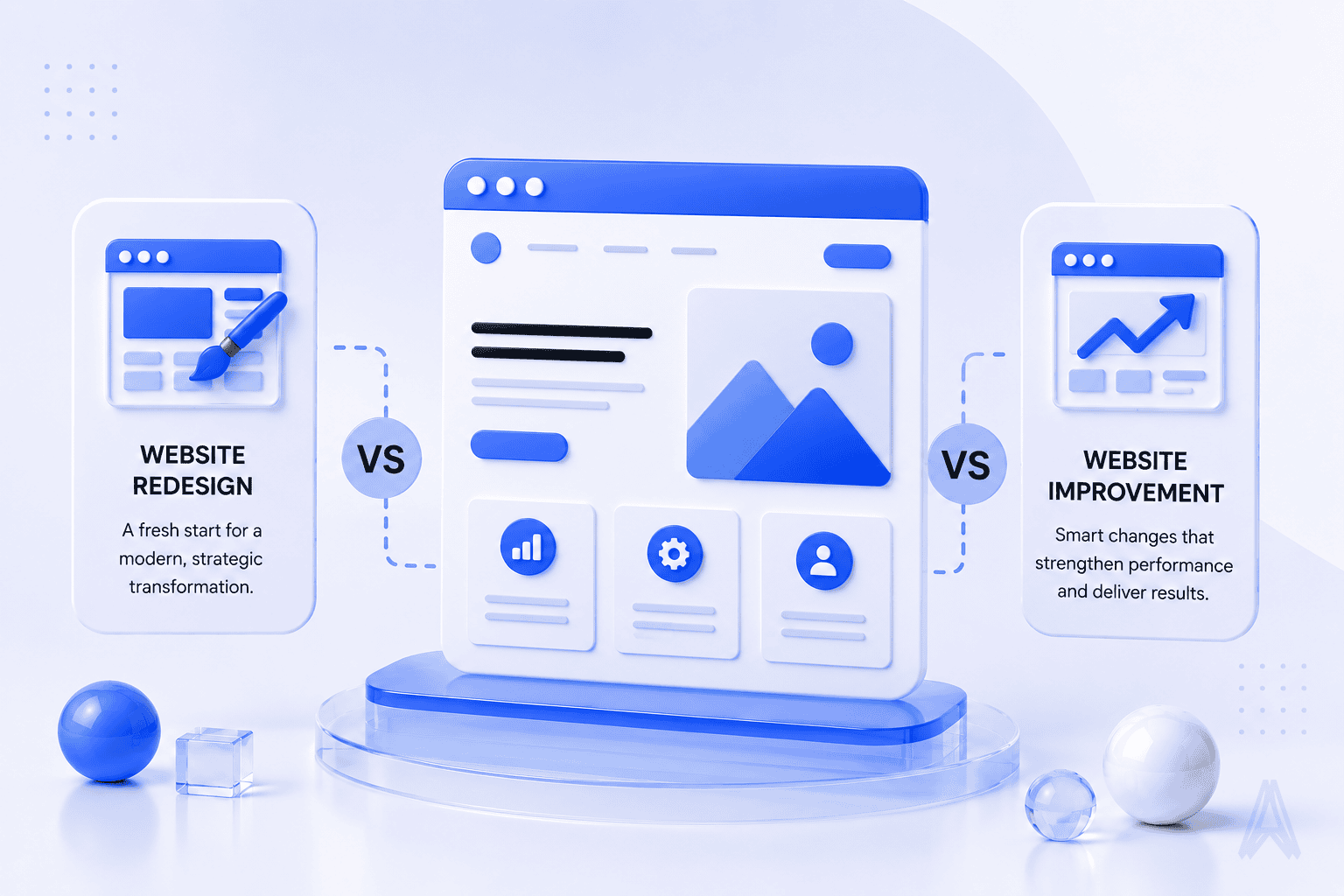
When a website is not generating enough enquiries or sales, a complete redesign can feel like the obvious solution. Sometimes it is. But not every underperforming website needs to be replaced. The real issue may be unclear content, weak calls to action, slow loading, poor mobile presentation or missing search engine optimisation. These problems can often be improved without rebuilding the entire website. The right decision depends on what is wrong, what the business needs to achieve and whether the current website can support those goals. This guide will help you understand the difference between a website redesign and a website improvement project.
What is a website improvement?
A website improvement project keeps most of the existing website but updates specific areas that are causing problems.
Improvements might include:
- Rewriting the homepage
- Improving service descriptions
- Changing the page structure
- Adding stronger calls to action
- Correcting mobile layouts
- Improving website speed
- Adding SEO titles and descriptions
- Updating images
- Simplifying contact forms
- Creating new service pages
- Fixing broken links or technical issues
This approach is suitable when the basic website platform and structure are still usable. The project focuses on the parts that need attention rather than replacing everything.
What is a website redesign?
A website redesign usually involves making significant changes to the structure, appearance, content and customer journey. In some cases, the website is rebuilt using a different platform or technical setup.
A redesign may include:
- A completely new layout
- New navigation and page structure
- Rewritten content
- Updated branding
- New service or product pages
- Better mobile layouts
- New forms or booking systems
- Improved SEO foundations
- E-commerce functionality
- New integrations
- Migration to another platform
A redesign is more than changing colours and images. It should address larger business, content, design and technical problems.
What are the signs that smaller improvements may be enough?
A full redesign may not be necessary when the website has a solid foundation.
The website still represents your business
If your services, audience and brand have not changed significantly, the existing structure may still be useful. You may only need clearer content, updated visuals or stronger calls to action.
The platform is easy to manage
If your team can update pages, add content and maintain the website without major technical problems, there may be no reason to move to a new system.
Only certain pages are underperforming
Perhaps the homepage is unclear, but the rest of the website works well. Or one service page receives traffic but does not generate enquiries. Focused improvements may solve these problems.
The website works well on mobile devices
If the website already adjusts properly across different screens, you may only need smaller design and content corrections.
The main technical setup is reliable
When the website is secure, regularly updated and supported by the platform, improvement may be more practical than replacement.
The business needs results quickly
A focused improvement project can sometimes be completed faster than a full redesign. This can be useful when the business has an upcoming campaign, event or launch.
What are the signs that you may need a full redesign?
A redesign becomes more appropriate when the problems affect the entire website.
Your business has changed
Your existing website may no longer reflect what the business offers.
This often happens when a company:
- Adds new services
- Changes its target audience
- Expands into new markets
- Introduces e-commerce
- Changes its positioning
- Rebrands
- Moves from local to international services
When the business has changed significantly, small content edits may not be enough.
Visitors cannot understand the offer
If the messaging is unclear across the entire website, the structure may need to be reconsidered. Adding more text to the existing pages may only make the website harder to understand.
The website is difficult to use on mobile devices
Older websites may not adapt properly to phones and tablets. Text may be too small, menus may be difficult to use and buttons may be hard to tap. When mobile problems affect most pages, a redesign may be more efficient.
The website is difficult to update
If every simple change requires technical help, the platform or website setup may no longer be suitable. A modern content management system can make routine updates easier.
The website is slow or technically unstable
Repeated errors, outdated software, plugin conflicts and poor performance can indicate deeper problems. Fixing each issue separately may cost more over time than rebuilding the website on a stronger foundation.
The navigation has become confusing
Businesses often add new pages over several years without reviewing the full structure.
The result can be:
- Too many menu items
- Repeated information
- Important services hidden inside dropdowns
- Outdated pages
- No clear customer journey
A redesign allows the information to be reorganised around current customer needs.
You need significant new functionality
A redesign may be necessary when adding:
- A full online store
- Membership features
- Customer accounts
- Complex booking
- Multilingual functionality
- Advanced integrations
- Custom workflows
The existing website should be reviewed before adding large new systems.
Does an outdated visual design mean the website needs rebuilding?
Not always.
A website may look outdated because of:
- Old photographs
- Inconsistent fonts
- Poor spacing
- Too many colours
- Small text
- Outdated icons
- Crowded sections
Some of these problems can be corrected without changing the entire structure. However, if the design system is inconsistent across every page, a redesign may provide a cleaner and more efficient result. The decision should not be based only on personal taste. Ask whether the design makes the business appear credible, helps customers understand the offer and supports the desired action.
What if the website looks good but does not generate enquiries?
A visually attractive website can still underperform.
Common reasons include:
- The offer is not clear.
- The wrong audience is visiting the website.
- Important services are difficult to find.
- The website has no strong calls to action.
- Visitors do not see enough proof or trust signals.
- The contact form asks for too much information.
- The website does not appear in relevant searches.
- Service pages do not answer customer questions.
- The website receives very little traffic.
In this situation, a redesign may not be the first step. It is often better to review analytics, search visibility, page content and the customer journey before deciding what needs to change.
What is a website audit?
A website audit is a structured review of the current website.
It helps identify problems related to:
- Message clarity
- Page structure
- Calls to action
- Mobile experience
- Trust
- SEO
- Performance
- Contact and conversion paths
The audit should explain:
- What is working
- What is creating confusion
- Which problems are most important
- What can be improved
- Whether a redesign is recommended
An audit is useful when you know the website needs attention but are unsure how much work is necessary.
How do you decide between improvement and redesign?
Start by answering five questions.
1. Does the website still match the business?
If your offer, audience or positioning has changed significantly, a redesign may be necessary.
2. Can the current platform support what you need?
If the platform cannot support important functionality or is difficult to maintain, rebuilding may be more practical.
3. Are the problems limited or widespread?
One weak page may need improvement. A confusing experience across the whole website may require redesign.
4. Is the website technically healthy?
A stable and manageable website is easier to improve. An outdated and unreliable website may not be worth repairing repeatedly.
5. What result does the business need?
The project should be guided by business goals.
You may need:
- More enquiries
- Better search visibility
- Stronger credibility
- Online sales
- Easier website management
- A clearer service structure
- Support for a new market
The required result will help determine the correct level of work.
Which option costs less?
Focused website improvements usually cost less than a complete redesign because less work is involved. However, smaller changes are not always the cheaper long-term option. If the website has serious technical or structural problems, repeatedly repairing individual issues can become expensive.
A professional review should consider:
- The current platform
- The condition of the website
- The number of pages
- The required changes
- Future business plans
- Ongoing maintenance needs
The cheapest immediate option is not always the most practical investment.
Can a website be improved in stages?
Yes. A staged approach may work well when the business needs to control cost or avoid a long project.
For example:
Stage one: Clarify the message
Update the homepage, main service pages and calls to action.
Stage two: Improve performance and mobile experience
Correct layout problems, optimise images and improve loading speed.
Stage three: Strengthen SEO
Add metadata, improve page content and create useful resource articles.
Stage four: Add functionality
Introduce booking, e-commerce, automation or other tools when needed.
A staged plan should still follow an overall strategy. Otherwise, the website may become inconsistent again.
Questions to ask before approving a redesign
Before committing to a full redesign, ask the agency:
- Why is a redesign recommended?
- Which current problems will it solve?
- Can any existing content or functionality be retained?
- Will the page structure change?
- Will SEO be considered during the project?
- Who prepares the content?
- What platform will be used?
- How will the website be managed after launch?
- What is included in the price?
- What happens to the existing website during the project?
A professional provider should be able to explain the recommendation in clear language.
Final thoughts
A website redesign should solve a real problem. It should not be recommended simply because the website is several years old or because a new visual trend has appeared. Sometimes a business needs a completely new structure, message and technical foundation. In other situations, focused improvements can produce a better result with less disruption. The best starting point is understanding what is preventing the current website from performing better. AmemIT helps small businesses and startups assess, improve and redesign business websites. We can review your current website, identify the most important problems and recommend whether you need focused improvements, a full redesign or a staged plan.
Contact us to request a website review or discuss your redesign project.